Best AI-Powered CRM in 2026
Why Zoho’s Architecture Outperforms Salesforce, HubSpot & Microsoft
Businesses searching for CRM with AI capabilities face a critical decision: choose a platform with bolted-on AI features, or implement a system architected for intelligence from the ground up.
We run our entire business on Zoho CRM with Zia AI. Every function (sales, marketing, recruitment, finance, client management) operates through AI-powered workflows. This isn’t a case study. It’s our operational reality, tested daily at scale.
As a Zoho Premium Partner implementing dozens of UK deployments annually, we see something most integrators miss: the gap between AI-powered CRM promises and actual operational transformation is widening, not closing.
By 2025, 81% of organisations expect to use AI-powered CRM systems. [1] Right now, only 12% have actually integrated AI tools into their processes. [2] The companies succeeding significant uplifts reported in some deployments. [3] The ones failing? They’re implementing AI features on platforms that were never architected for intelligence to emerge.
Here’s what we’ve learned from implementing complete Zoho ecosystems and staying current with every platform evolution: most CRM vendors bolted AI onto existing architectures. Zoho built their entire ecosystem with integrated intelligence as the foundation.
That architectural difference determines everything.

TL;DR: Best AI-powered CRM in 2026
- Zoho CRM + Zia (Zoho One) stands out when you want AI that can learn from connected data across sales, marketing, support, finance and delivery, not just a CRM database.
- Many CRM platforms offer AI features, but results depend on data access and architecture, not feature lists alone.
- When AI can see the wider operational context, it can improve lead prioritisation, forecasting, customer health signals and workflow automation more reliably.
- If your stack is fragmented across multiple tools, AI is often limited by siloed data, inconsistent processes and integration overhead.
Quick takeaway: prioritise unified data, consistent workflows and practical automation over bolt-on AI features.
Comparing AI-Powered CRM Platforms: What to Look for
When evaluating CRM systems with AI capabilities, businesses typically compare Salesforce Einstein, HubSpot AI, Microsoft Dynamics 365 Copilot, and Zoho CRM with Zia. Here’s what separates genuine AI integration from bolted-on features:
The AI CRM Evaluation Framework
AI Data Access Scope: Can the AI see across your entire operation, or just CRM data? Zoho’s Zia accesses 45+ unified applications. Competitor AI typically sees only CRM records, requiring expensive integrations to access marketing, finance, or support data.
Implementation Complexity: Are you deploying one ecosystem or integrating multiple vendors? Zoho provides a single, unified deployment. Salesforce, HubSpot, and Microsoft require stitching together acquired companies (Slack, Tableau, LinkedIn) through custom APIs.
True Cost Analysis: Most AI-powered CRM comparisons focus on base licence costs but ignore integration middleware, custom development, and ongoing maintenance. Zoho CRM pricing includes AI capabilities at every tier, and Zoho One bundles provide complete business ecosystems without stacked licences. We help clients determine which bundle fits their operational needs.
AI Learning Architecture: Does AI performance improve as you add applications, or does each tool operate in isolation? Zoho’s unified architecture creates network effects – every application makes Zia smarter. Fragmented platforms can’t replicate this.
This comparison reveals why businesses searching for “CRM with AI” need to evaluate architecture, not just feature checklists.
Why Zoho’s Ecosystem Architecture Changes Everything
Most businesses approach CRM as a standalone tool. Sales uses it to track deals. Marketing maybe syncs their email campaigns. Support logs tickets. Each function operates in isolation, data fragmenting across systems, AI features unable to see the full operational picture.
We’ve migrated dozens of organisations away from this model. They came from Salesforce, HubSpot, Microsoft Dynamics, Pipedrive – platforms where AI capabilities exist but can’t compound because the underlying architecture treats CRM as one application among many.
Zoho built differently from the ground up.
The Zoho One Advantage: Unified Intelligence Across Your Entire Operation
When we implement Zoho, we’re not deploying a CRM system. We’re architecting a complete business operating system where intelligence flows through every function:
Zia doesn’t just analyse your sales pipeline. It sees your marketing engagement (Campaigns, Social), your customer support patterns (Desk), your project delivery timelines (Projects), your financial health (Books), your recruitment pipeline (Recruit), your internal collaboration patterns (Cliq, Connect). Every interaction, every transaction, every workflow across your entire operation feeds the same AI engine.
That’s not incremental improvement. That’s a structural advantage competitors can’t replicate without rebuilding their entire technology stack.
What This Means for AI Performance
When Zia predicts which leads will convert, it’s not guessing based on CRM data alone. It’s analysing:
- How prospects engage with your knowledge base content (Desk)
- Which marketing campaigns drove their initial interest (Campaigns)
- How quickly your team responds to enquiries (Cliq integration)
- Whether similar customers historically churned or expanded (Books data)
- Project delivery patterns that indicate capacity to take on new work (Projects)
That’s why we see conversion rate improvements doubling when clients move to fully integrated Zoho deployments. [4] The AI isn’t smarter because of better algorithms. It’s smarter because it can see the full operational context.
The Implementation Reality: What Premium Partners See
Here’s what happens in a typical Zoho deployment we run:
Week 1-2: We audit the client’s current systems. Usually, they’re running 8-15 disconnected tools. CRM here, accounting there, project management somewhere else, support desk in another platform. Each has “AI features.” None can talk to each other.
Week 3-8: We implement the complete Zoho ecosystem. Not just CRM – the entire operational substrate. Every application configured to feed Zia the context it needs.
Week 9 onwards: Intelligence starts compounding. Zia begins identifying patterns the old fragmented systems could never see. Sales forecasting accuracy improves. [5] Support issues get flagged before customers escalate. Marketing attribution becomes transparent. Financial forecasting tightens.
The businesses seeing 45% revenue increases from AI-powered CRM? [3] They’re not just using AI features. They’re operating on unified architecture where intelligence can actually emerge.
Why Competitors Can’t Match This
Quick comparison: here’s a high-level view of how the major platforms typically differ when it comes to AI data scope and ecosystem architecture.
| What matters for AI CRM | Zoho CRM + Zia | Salesforce | HubSpot | Microsoft Dynamics 365 |
|---|---|---|---|---|
| AI data scope | Can use wider suite context (Zoho apps) when deployed as an ecosystem | Strong AI, often depends on connected products and integrations | Strong for marketing-led CRM workflows | Strong in Microsoft-first environments |
| Architecture approach | Unified suite available under Zoho One | Ecosystem via multiple products and integrations | All-in-one feel for marketing and sales teams | Best when aligned with Microsoft stack |
| Implementation complexity | Often simpler if using Zoho suite | Can be complex depending on customisation and integrations | Typically quick to deploy for standard use cases | Varies widely with configuration and integrations |
| Hidden cost drivers | Usually fewer add-ons if suite is used | Add-ons, integrations, and admin overhead | Scaling across teams and hubs can increase cost | Licensing plus integration and setup effort |
| Best fit | Businesses wanting unified operations and automation | Enterprise teams needing deep customisation | Marketing-led growth teams and fast onboarding | Organisations already invested in Microsoft |
Note: This is a high-level overview. Specific capabilities depend on licensing, configuration, and the connected tools in your stack.
Other CRM vendors face a structural problem: they built their platforms as standalone products, then tried to create “ecosystems” through acquisitions and integrations. Salesforce bought Slack, Tableau, MuleSoft – attempting to stitch together what Zoho built as a unified system from day one.
The difference shows in deployment complexity and ongoing maintenance. When we migrate clients from these platforms, they’re often paying for:
- The CRM licence
- Separate marketing automation platform
- Different support desk solution
- Third-party integration middleware
- Custom API development to connect everything
- Ongoing maintenance as each system updates independently
Zoho One provides 45+ applications on unified architecture. One licence. One authentication system. One AI engine learning across everything. Updates roll out cohesively across the platform.
That’s not just cost efficiency. It’s the architectural foundation that allows AI to function as intended.
Zoho’s AI Capabilities: What Zia Actually Does
As Premium Partners staying current with every Zoho platform evolution, we track Zia’s development closely. The 2025 enhancements positioned it well ahead of competitor AI offerings. Here’s what we’re deploying for clients now:
Predictive Lead Scoring and Deal Intelligence
98% of sales teams using AI think it improves lead prioritisation. [5] That’s near-universal validation.
Zia’s predictive lead scoring analyses hundreds of variables simultaneously: not just CRM engagement, but cross-platform behavioural patterns. It knows which marketing campaigns converted historically, which support interactions indicate serious buying intent, which project timelines suggest capacity issues.
For deals already in pipeline, Zia calculates win probability based on: engagement velocity, stakeholder involvement patterns, competitive signals, historical close rates for similar deal profiles, and current team capacity to deliver. Sales teams stop guessing. They know where to focus energy.
Sentiment Analysis Across Every Customer Touchpoint
Because Zia operates across the entire Zoho ecosystem, sentiment analysis isn’t limited to support tickets. It monitors:
- Sales email exchanges and call transcripts
- Support ticket tone and escalation patterns
- Project communication sentiment in Zoho Projects
- Survey responses through Zoho Survey
- Social media interactions via Zoho Social
When frustration emerges anywhere in the customer journey, Zia flags it. Account managers get alerts before customers churn. Support teams intervene before one negative interaction becomes a pattern. Project managers address communication issues before delivery suffers.
The result: organisations leveraging this level of integrated sentiment analysis see customer satisfaction scores increase by 10% or more whilst reducing support costs by 20-30%.
Generative AI That Understands Your Business Context
The 2025 Zia updates included generative AI capabilities that go beyond generic content creation. Because Zia has access to your complete business context, it drafts:
- Sales emails referencing specific customer interactions across platforms
- Proposals incorporating accurate project timelines from your delivery history
- Support responses drawing from your knowledge base and past resolution patterns
- Reports synthesising data from CRM, finance, projects, and marketing
- Meeting summaries with action items automatically routed to the right workflows
This isn’t a chatbot generating generic responses. It’s an AI assistant that knows your business, your customers, your delivery patterns, and your team capacity. The content it creates is contextually accurate because it operates on unified data.
Churn Prediction and Prevention
Zia identifies customers at risk of churn through behavioural analysis across your entire operation: not just support tickets, but payment patterns (Books), project engagement (Projects), product usage data, and communication frequency.
For subscription businesses, Zia indicates which specific product or service a customer might churn from and why. That’s preventative intelligence. You’re not responding to cancellations. You’re addressing the conditions that create them before they materialise.
Workflow Automation With True Intelligence
87% of sales teams report dissatisfaction with CRM complexity and manual tasks. Zia’s workflow automation solves this through natural language configuration and intelligent triggering.
Non-technical users can create sophisticated automations using simple prompts: “When a high-value lead downloads our pricing guide, notify the sales director and create a task for follow-up within 2 hours.” Zia translates that into a cross-platform workflow connecting Campaigns, CRM, and Cliq.
Better still, workflows adapt based on AI recommendations. Zia might suggest: “Leads from this industry typically convert faster when contacted within 30 minutes rather than 2 hours.” The system learns from your operational reality and optimises itself.
Data entry happens automatically as Zia watches email exchanges, call recordings, and meeting notes. Sales teams focus on conversations. The system absorbs the administrative complexity.
The Implementation Reality: How Zoho’s Architecture Solves What Others Can’t
65% of businesses use CRM systems with generative AI capabilities. [6] Those using it are 83% more likely to exceed sales goals. [7] Yet the adoption gap persists.
As Premium Partners, we see exactly why. The problem isn’t AI capability – it’s platform architecture.
The Three Problems Zoho’s Design Eliminates
1. Fragmented Systems – Zoho’s Unified Architecture
Most AI implementations fail because data lives in silos. Marketing automation here, CRM there, finance somewhere else, support in another system.
The AI can see individual puzzle pieces but never the full picture. Zoho solved this by building every application on the same architecture from day one. When we deploy Zoho One, clients get 45+ applications sharing the same database structure, authentication system, and AI engine. Zia doesn’t just access CRM data – it sees the complete operational context across every business function.
That’s why we see AI performance improve dramatically when clients move from fragmented toolsets to full Zoho implementations. The intelligence can finally compound.
2. Lack of Operational Symmetry – Zoho’s Standardised Workflows
AI learns from consistency. If every team uses systems differently, if data entry standards vary, if workflows are improvised, the AI can’t identify patterns.
Zoho’s unified platform enforces operational symmetry naturally. When we implement it, we’re not integrating disparate systems with different data models. We’re configuring one cohesive platform where workflows, data structures, and processes align by design.
This isn’t restrictive – it’s liberating. Teams get the flexibility they need within a framework that allows AI to learn effectively.
3. Implementation Without Architecture – Zoho’s Ecosystem Approach
Most businesses implement AI as bolt-on features to existing processes. They add intelligence to inefficient workflows and wonder why efficiency doesn’t improve.
Our implementation methodology treats Zoho deployment as business architecture, not software installation. We’re redesigning operational structure around what unified intelligence makes possible. That requires thinking like architects, not tool users.
The businesses seeing 45% revenue increases from AI-powered CRM? [3] They’re working with partners who understand this distinction.
What Staying Current With Zoho’s Evolution Means for Our Customers
As a Premium Partner, we track every Zoho platform update, feature release, and capability enhancement. This isn’t passive observation – it’s strategic advantage for the organisations we work with.
Continuous Platform Evolution
Zoho releases updates across their ecosystem constantly. Zia’s 2025 enhancements alone included sharper predictive forecasting, expanded generative AI capabilities, and deeper cross-platform intelligence. Most businesses miss these improvements because they’re not monitoring the platform systematically.
We implement these enhancements for clients as they roll out. Your Zoho deployment doesn’t become static – it evolves as the platform advances.
Early Access to New Capabilities
Premium Partners often get early access to features before general release. This allows us to test new capabilities in our own operation, understand implementation nuances, and deploy proven configurations for clients.
When Zia’s generative AI features launched, we’d already been testing them for weeks. Our clients benefitted from refined implementation methodology, not experimental deployment.
Deep Ecosystem Knowledge
Running our entire business on Zoho means we understand how the pieces fit together operationally. We don’t just know that Zia can analyse sentiment – we know how sentiment data from Zoho Desk triggers workflows in CRM, updates forecasts in Analytics, and influences resource allocation in Projects.
That’s the difference between software implementation and ecosystem architecture.
Why the Zoho Advantage Compounds Over Time
Companies adopting automation technologies see 20-30% increases in sales productivity and 10-20% increases in revenue growth, according to McKinsey research. [8]
Those gains compound on Zoho’s unified architecture faster than on fragmented platforms. Here’s why:
Network effects within the ecosystem. Every application you add to your Zoho deployment makes Zia smarter. When you implement Zoho Projects alongside CRM, Zia can suddenly correlate sales cycles with delivery capacity. Add Zoho Books, and financial health becomes a factor in deal prioritisation. Each addition creates exponential intelligence gains, not linear ones.
Continuous learning from unified data. Zia doesn’t just analyse yesterday’s data – it learns from every interaction across your operation in real time. The longer you operate on Zoho’s unified architecture, the smarter your AI becomes. Competitors on fragmented platforms can’t replicate this because their AI can’t see across silos.
Reduced technical debt. Every custom integration is technical debt requiring ongoing maintenance. When APIs change, integrations break. When systems update, compatibility issues emerge. Zoho’s unified architecture eliminates this burden entirely. Your operational infrastructure becomes more stable, not more fragile, as you scale.
This is why organisations that fully commit to the Zoho ecosystem pull away from competitors trying to stitch together best-of-breed point solutions. The advantage compounds.
Why Work with A2Z Cloud
The distance between knowing AI in CRM is valuable and actually implementing it operationally is where most businesses get stuck.
You need more than software licences. You need:
- Architectural expertise that understands how Zoho’s ecosystem components integrate for maximum AI performance
- Operational proof from partners who run their own business on the platform they’re recommending
- Current knowledge of every platform evolution, feature release, and capability enhancement
- Implementation methodology that treats deployment as business transformation, not software installation
We run our entire operation (recruitment, finance, communication, marketing, client management) on Zoho. Every day, we test the platform at scale in real business conditions. When we implement Zoho ecosystems for clients, we’re replicating proven infrastructure, not experimenting with theory.
As a Premium Partner, we stay ahead of platform developments. The businesses we work with benefit from early access to new capabilities, refined implementation approaches, and deep ecosystem knowledge that comes from living on the platform.
The market has moved to AI-powered CRM. But the question isn’t whether to adopt AI – it’s whether to adopt it on architecture designed for intelligence to compound.
Zoho built that architecture. Most CRM vendors are still trying to retrofit it onto platforms designed in the pre-AI era.
If you’re ready to implement CRM AI on architecture that actually works, we should talk. We don’t sell software licences – we architect unified business systems where intelligence emerges naturally. Get in touch and let’s map what a complete Zoho ecosystem implementation looks like for your operation.
Frequently Asked Questions: AI-Powered CRM
What is the best AI-powered CRM in 2026?
There is no single best fit for every business, but Zoho CRM with Zia is a strong option if you want AI that can learn from more than just sales records. Because Zoho can run as part of a unified ecosystem (Zoho One), Zia can use context from sales, marketing, support, finance, projects and more. Many alternative CRMs offer AI features, but often rely on integrations to pull in that wider operational data.
How much does AI-powered CRM cost?
AI-powered CRM pricing varies depending on user count, the features you need, and whether you want a full suite or a standalone CRM. Zoho CRM pricing includes AI capabilities across tiers, and Zoho One bundles can be a cost-effective route if you want multiple business applications under one licence. If you are comparing platforms, make sure you account for add-ons such as marketing automation, support desk tools, reporting, integrations, and ongoing admin time.
Can AI in CRM actually improve sales performance?
Yes, it can. AI features such as lead scoring, forecasting, next-best actions and automation can improve focus and consistency, especially when the system has access to clean, connected data. Results vary by business, but the biggest gains typically come when AI is paired with well-defined processes, good data hygiene, and workflows that reduce manual admin for sales teams.
What’s the difference between Zoho CRM and Salesforce Einstein??
The biggest difference is how the wider ecosystem is structured. Zoho is designed to work as a unified suite, which can make it easier for AI to use context across multiple business functions. Salesforce has strong AI capabilities, but businesses often rely on separate tools and integrations to connect marketing, collaboration, analytics and other systems. In practice, this can affect complexity, implementation effort, and ongoing maintenance depending on your stack.
How long does it take to implement AI-powered CRM?
Implementation time depends on what you are deploying, how many teams are involved, and how much data needs to be migrated. A basic CRM rollout can be completed relatively quickly, while a full-suite implementation (CRM plus marketing, support, finance and projects) will take longer due to process design, configuration, data migration and training. The fastest projects are the ones with clear requirements, a defined workflow, and committed internal owners.
Do I need technical expertise to use AI in Zoho CRM?
Not necessarily. Many Zia features are built into the product, and users can benefit from AI insights and automation without writing code. Zoho also supports workflow and automation tools that can be configured by non-technical users. That said, working with an implementation partner can help ensure data structure, permissions and workflows are set up in a way that supports AI performance and adoption.
Which industries benefit most from AI-powered CRM?
AI-powered CRM tends to work well for organisations with multi-step sales cycles, repeat enquiries, multiple customer touchpoints, or teams that need consistent follow-up. This includes professional services, recruitment, manufacturing, healthcare, education, and B2B service providers. Subscription and retention-led businesses can also benefit where churn risk, renewal timing and customer health signals are important.
Can I migrate from Salesforce/HubSpot/Microsoft to Zoho CRM?
Yes. CRM migrations are common and typically include data migration, workflow mapping, pipeline and field configuration, user training, and testing. Timelines vary based on data volume and complexity, plus how many connected systems need to be moved or integrated. A structured migration plan helps reduce disruption and avoids losing reporting history or workflow logic.
Ready to Implement AI-Powered CRM That Actually Works?
If you’re evaluating CRM systems with AI capabilities, focus on how AI will access the data it needs and how your processes will support adoption. AI features work best when they sit on top of connected systems and consistent workflows.
Here’s how we help:
- Zoho ecosystem audit and architecture planning
- Deployment across CRM, marketing, support, finance, and projects
- Workflow automation and AI configuration aligned to your processes
- Migration support from Salesforce, HubSpot, and Microsoft Dynamics
- Ongoing optimisation as your needs and the platform evolve
As a Zoho Premium Partner, we help organisations design and implement Zoho systems that support practical automation and measurable operational improvements.
Book a Zoho CRM Consultation: Get in touch for a no-obligation assessment of your current setup and a roadmap for implementation.
References
- SuperAGI (2025). “Future of CRM: Trends and Innovations in AI-Powered Customer Relationship Management for 2025.” 81% of organizations expected to use AI-powered CRM systems by 2025.
- AIMultiple (2026). “CRM AI Systems: Top 5 Vendors and Key Features in 2026.” Research by Freshworks. Only 12% of CRM users actually use a CRM AI tool in their processes.
- Medium/Empathy First Media (2025). “Integrate AI Lead Scoring into B2B CRM.” Companies implementing AI lead scoring see a 45% increase in lead-to-opportunity conversion rates.
- Naya AI (2025). “Case Study: How AI Lead Scoring Boosts Conversion Rates and Sales Efficiency.” Some implementations reported conversion rate doubling.
- Salesforce (2023). “Predictive Lead Scoring + AI is a Game Changer.” 98% of sales teams using AI think it improves lead prioritisation.
- CRM.org (2025). “45 CRM Statistics You Need to Know in 2025.” 65% of businesses have already adopted CRM systems with generative AI.
- CRM.org & Freshworks (2024-2025). “CRM Statistics & Trends.” Businesses using generative AI in their CRM are 83% more likely to exceed sales goals.
- SuperAGI (2025). “Top 10 CRM Trends to Watch in 2025.” McKinsey data. Companies that adopt automation technologies can see a 20-30% increase in sales productivity and a 10-20% increase in revenue growth.
Ready to harness AI in your business?
Book a free consultation with our team today! Let’s chat about your goals, challenges, and how we can help you unlock your business’s full potential.

Share this article
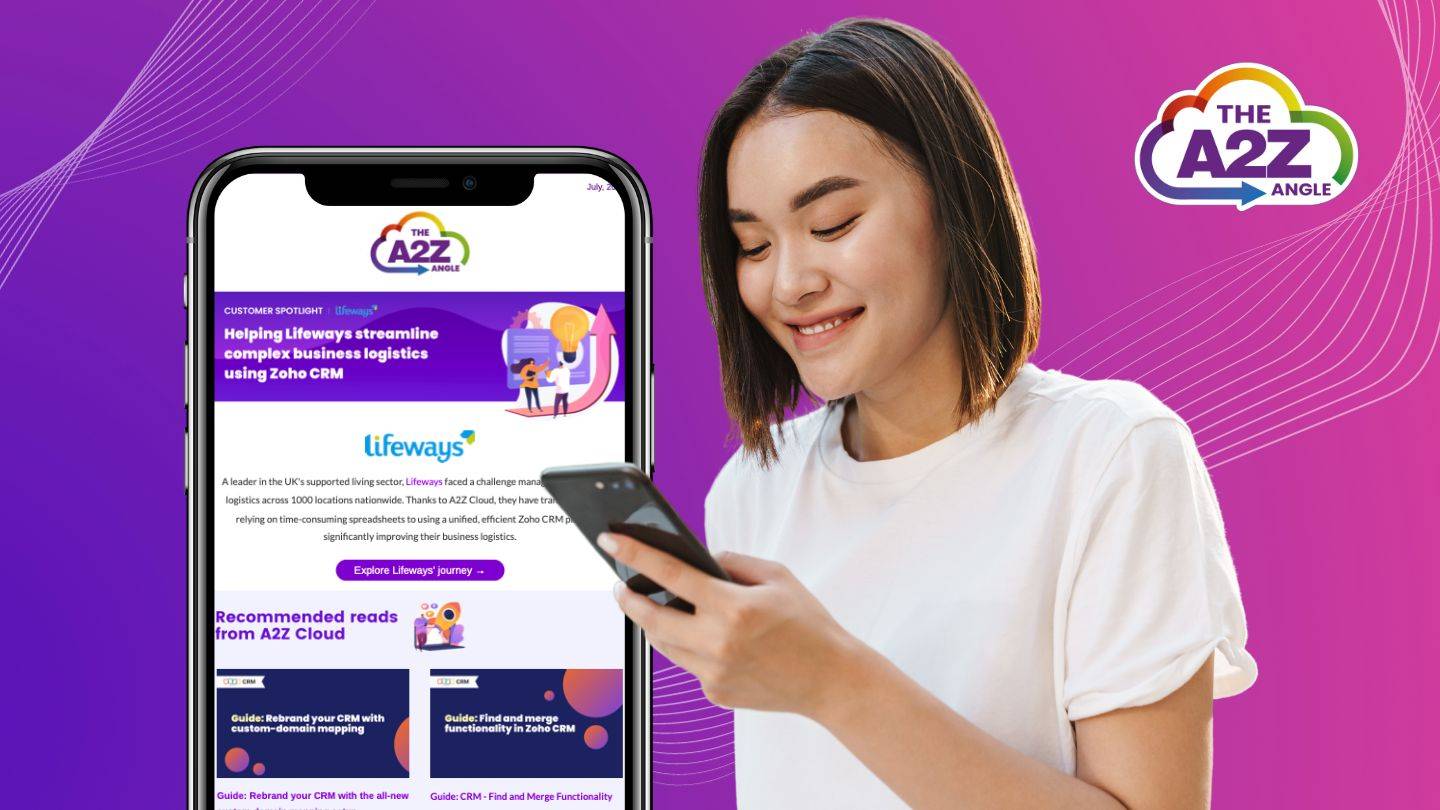
Join the A2Z Angle
Looking to stay ahead of the curve in the fast-paced world of tech? Look no further than A2Z Cloud's monthly newsletter. Join us today for exclusive access to deep dives on all the techie subjects you crave, with must read content from our top partners, plus exciting event announcements and inspiring customer stories.
It's all delivered straight to your inbox, once a month only, so you never miss a beat. Sign up below.